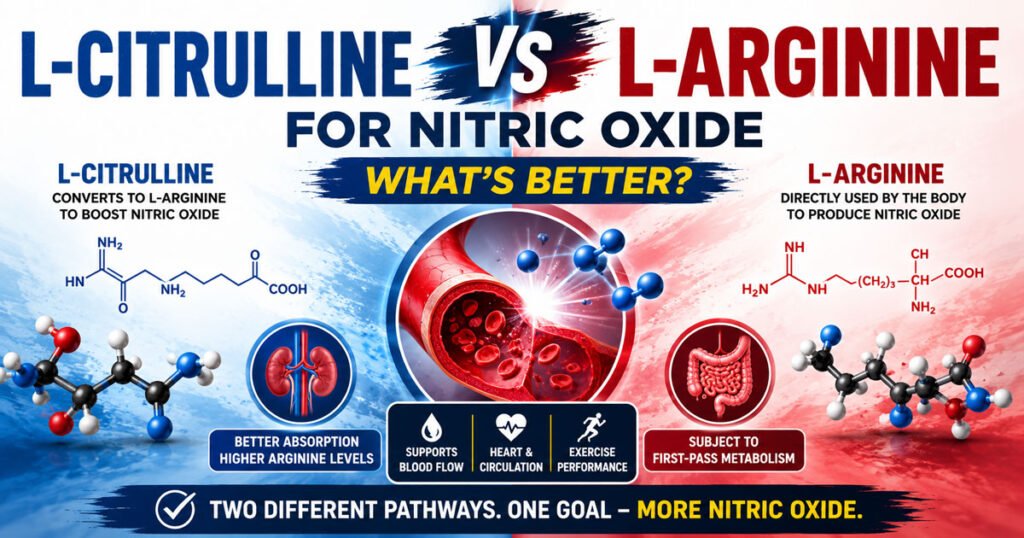
If you’re comparing L-Citrulline vs L-Arginine for nitric oxide, both amino acids are closely connected to the body’s natural nitric oxide pathway. However, they reach that pathway in different ways, and the body handles each one differently.
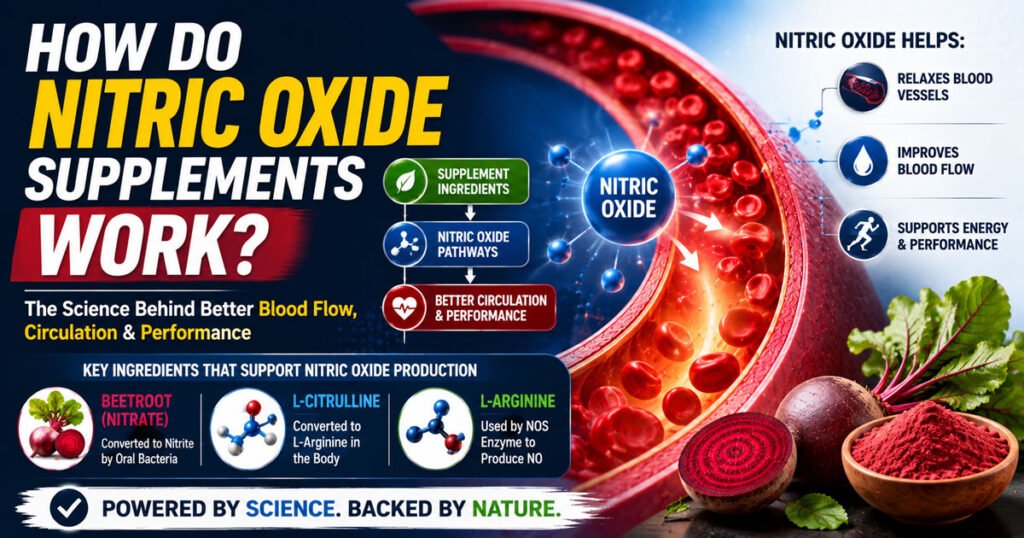
L-arginine is directly used by an enzyme called nitric oxide synthase to produce nitric oxide. L-citrulline, on the other hand, can be converted by the body into L-arginine, helping increase the amount of arginine available for nitric oxide production.
So, is L-citrulline better than L-arginine? The answer isn’t quite that simple. Research suggests that L-citrulline can raise blood arginine levels efficiently, but the effects of either supplement can vary depending on the person, dosage, health status, and purpose of use.
What Are L-Citrulline and L-Arginine?
L-arginine and L-citrulline are amino acids involved in several normal processes throughout the body.
L-arginine is a substrate used by nitric oxide synthase, or NOS, to produce nitric oxide. This means L-arginine is directly involved in one of the body’s main nitric oxide-producing pathways.
L-citrulline works somewhat differently. The body can convert L-citrulline into L-arginine, which can then be used in the nitric oxide pathway.
Because of this relationship, both amino acids have been studied as potential ways of influencing nitric oxide availability and vascular function.
How Does L-Arginine Support Nitric Oxide?
L-arginine is directly involved in the enzymatic production of nitric oxide.
Inside the body, nitric oxide synthase uses L-arginine as a substrate. This reaction produces nitric oxide along with another amino acid called L-citrulline.
In simple terms, you can think of L-arginine as one of the raw materials used by the nitric oxide synthase pathway.
Because of this role, researchers have investigated L-arginine supplementation for its potential effects on nitric oxide production, vascular function, and blood pressure.
However, taking L-arginine orally does not necessarily mean that all of it becomes available for nitric oxide production. A significant amount can be metabolized in the intestine and liver before reaching the wider circulation.
How Does L-Citrulline Support Nitric Oxide?
L-citrulline takes a different route.
After oral consumption, L-citrulline can be converted into L-arginine through metabolic pathways, particularly in the kidneys and other tissues.
This means L-citrulline can indirectly support the nitric oxide pathway by helping increase circulating L-arginine.
Research comparing the two amino acids has found that oral L-citrulline can raise plasma L-arginine levels efficiently. One pharmacokinetic study found that L-citrulline supplementation produced substantial increases in plasma arginine and, at certain doses, produced greater arginine exposure than comparable doses of oral L-arginine.
L-Citrulline vs L-Arginine: The Main Difference
The easiest way to understand the difference is to look at where each amino acid enters the pathway.
| Feature | L-Citrulline | L-Arginine |
|---|---|---|
| Role in nitric oxide pathway | Precursor that can increase L-arginine availability | Direct substrate for nitric oxide synthase |
| Relationship to arginine | Converted into L-arginine | Already is L-arginine |
| Oral metabolism | Less affected by intestinal and hepatic first-pass metabolism | Subject to significant first-pass metabolism |
| Research focus | Arginine availability, vascular function and exercise | Nitric oxide production, vascular function and blood pressure |
This difference in metabolism is one of the main reasons researchers have become interested in L-citrulline as an alternative way of increasing arginine availability.
Why Does L-Citrulline Often Raise Arginine More Efficiently?
One important factor is first-pass metabolism.
When L-arginine is consumed orally, some of it is metabolized in the gastrointestinal tract and liver before reaching systemic circulation. This can limit how much of the ingested arginine becomes available in the bloodstream.
L-citrulline is handled differently. It is not extensively extracted by the intestine and liver in the same way as oral L-arginine. Instead, it can reach the circulation and later be converted into L-arginine.
Human pharmacokinetic research has demonstrated that L-citrulline supplementation can substantially increase plasma L-arginine levels.
This does not automatically mean that L-citrulline will produce a better outcome for every person. It simply helps explain why L-citrulline is widely studied as an alternative source for increasing arginine availability.
What Does Research Say About L-Citrulline vs L-Arginine?
Research comparing L-citrulline and L-arginine has produced interesting findings, but the evidence is not completely uniform.
A review of oral L-arginine and L-citrulline supplementation found that both can increase plasma arginine levels. The review also reported that L-citrulline was approximately twice as potent in increasing plasma arginine under the conditions studied, which was attributed in part to lower first-pass metabolism.
Other research has investigated both amino acids in relation to blood pressure and vascular function. Some studies have reported reductions in blood pressure, while other analyses have found substantial variation between trials.
A more recent assessment of registered clinical trials highlighted the differences between studies, including participant characteristics, doses, treatment durations, and measured outcomes.
Therefore, it is better to describe L-citrulline and L-arginine as well-studied nitric oxide-related amino acids rather than claiming that one is universally superior.
L-Citrulline vs L-Arginine for Exercise
Both amino acids have been investigated in sports and exercise research.
The theory is relatively straightforward: nitric oxide is involved in vascular signaling, and changes in nitric oxide availability may influence blood flow and exercise-related physiological responses.
L-citrulline has received particular attention in sports nutrition because of its ability to increase circulating arginine levels.
Studies have investigated L-citrulline alone, L-citrulline combined with malate, and other formulations in relation to exercise performance and muscle-related outcomes.
However, the results are not consistent enough to say that L-citrulline will improve performance for everyone.
Your training status, exercise type, dosage, diet, overall health, and other factors can influence the outcome.
Can L-Citrulline and L-Arginine Be Used Together?
Some dietary supplements contain both L-citrulline and L-arginine.
The rationale is that the two amino acids can contribute to arginine availability through different routes. However, taking both does not automatically mean that more nitric oxide will be produced or that you’ll experience a particular benefit.
The appropriate combination and amount depend on the specific supplement and individual circumstances.
If you’re considering combining amino acid supplements, especially if you take prescription medication or have an existing health condition, speak with a qualified healthcare professional first.
What About L-Citrulline in Nitric Oxide Supplements?
L-citrulline is commonly included in nitric oxide supplements because of its relationship with L-arginine and the nitric oxide synthase pathway.
For example, CircO2 from Advanced Bionutritionals includes L-citrulline as part of its nitric oxide formula, along with ingredients such as beetroot powder and hawthorn berry extract.
This combination is designed by the manufacturer around multiple ingredients associated with nitric oxide and circulation support.
If you’re interested in exploring a nitric oxide supplement containing L-citrulline, you can review the current CircO2 formula, package options, pricing, and satisfaction guarantee below.
Affiliate Disclosure: We may earn a commission if you purchase CircO2 through our affiliate link, at no additional cost to you.
Which Is Better: L-Citrulline or L-Arginine?
There is no single answer that applies to everyone.
From a pharmacokinetic perspective, L-citrulline has an important advantage because it can raise plasma L-arginine efficiently while avoiding much of the first-pass metabolism that affects oral L-arginine.
L-arginine still has an important role because it is the direct substrate used by nitric oxide synthase.
For someone researching nitric oxide supplements, the more useful question may be which form and formulation has been studied for their specific goal rather than simply asking which amino acid is “better.”
What Factors Should You Consider?
If you’re considering an L-citrulline or L-arginine supplement, look beyond the ingredient name.
- Ingredient amount: Check how much L-citrulline or L-arginine is actually provided per serving.
- Other ingredients: Some formulas combine amino acids with beetroot, botanical extracts, vitamins, or minerals.
- Product instructions: Follow the manufacturer’s recommended serving rather than assuming more is better.
- Your health: Existing medical conditions and medications can affect whether a supplement is appropriate.
- Evidence: Look for human clinical research rather than relying solely on marketing claims.
Are L-Citrulline and L-Arginine the Same?
No. They are different amino acids, although they are closely connected within the body’s metabolism.
L-arginine can be directly used by nitric oxide synthase to produce nitric oxide. L-citrulline can be converted into L-arginine, which can then participate in the nitric oxide pathway.
Because of this relationship, both ingredients are frequently discussed together when talking about nitric oxide supplements.
Safety Considerations
L-citrulline and L-arginine are dietary ingredients that have been studied in humans, but that does not mean supplementation is appropriate for everyone.
Both can potentially influence blood pressure and vascular function. They may also interact with certain medications or be inappropriate in some medical situations.
If you take medication for blood pressure, heart conditions, erectile dysfunction, or other health conditions, consult your doctor or pharmacist before starting a nitric oxide supplement.
Pregnant or breastfeeding individuals should also seek professional medical advice before using concentrated dietary supplements.
Always read the product label and follow the manufacturer’s directions.
Frequently Asked Questions
1. Is L-citrulline better than L-arginine for nitric oxide?
L-citrulline can raise plasma L-arginine efficiently because it is less affected by first-pass metabolism. However, this does not mean it is universally better for every person or every purpose. Research results vary depending on the population, dosage, and outcome being studied.
2. Which is more effective for increasing arginine levels?
Human pharmacokinetic research suggests that L-citrulline can increase plasma L-arginine efficiently and may produce greater arginine exposure than comparable oral doses of L-arginine under certain conditions.
3. Does L-arginine directly produce nitric oxide?
L-arginine is the substrate used by nitric oxide synthase to produce nitric oxide. This makes it directly connected to the body’s nitric oxide synthesis pathway.
4. Does L-citrulline turn into L-arginine?
Yes. The body can convert L-citrulline into L-arginine through metabolic pathways. This is one reason L-citrulline is studied as a way to increase circulating arginine availability.
5. Is L-citrulline found in nitric oxide supplements?
Yes. L-citrulline is a common ingredient in nitric oxide supplements because of its relationship with L-arginine and nitric oxide synthesis.
6. Does CircO2 contain L-citrulline?
According to the manufacturer’s current product information, CircO2 contains L-citrulline as part of its proprietary nitric oxide blend, along with ingredients including beetroot powder and hawthorn berry extract.
Final Thoughts
The comparison of L-Citrulline vs L-Arginine for nitric oxide comes down largely to how the body processes these two amino acids.
L-arginine is directly used by nitric oxide synthase, while L-citrulline can be converted into L-arginine and may increase circulating arginine more efficiently because it avoids much of the first-pass metabolism associated with oral arginine.
Research supports a biological connection between both amino acids and nitric oxide metabolism, but the effects of supplementation can vary between individuals and studies.
Rather than viewing one ingredient as a guaranteed nitric oxide booster, consider the complete formula, dosage, evidence, your personal health circumstances, and the advice of a qualified healthcare professional.
If you’re looking for a convenient nitric oxide supplement containing L-citrulline alongside other ingredients, you can learn more about CircO2 from Advanced Bionutritionals.
EXPLORE CIRCO2 NITRIC OXIDE SUPPLEMENT →
This article is for general educational purposes only and is not intended to diagnose, treat, cure, or prevent any disease. Always read the product label and consult your doctor or qualified healthcare professional before starting a new dietary supplement, particularly if you take prescription medication or have an existing medical condition.
Sources & Further Reading
- Pharmacokinetic and pharmacodynamic properties of oral L-citrulline and L-arginine: impact on nitric oxide metabolism
- The Effects of Oral L-Arginine and L-Citrulline Supplementation on Blood Pressure
- L-Citrulline Supplementation: Impact on Cardiometabolic Health
- Dietary Supplements for Improving Nitric Oxide Synthesis
- Assessment of Registered Clinical Trial Designs: Comparison of L-Arginine and/or L-Citrulline Interventions