What Does Nitric Oxide Have to Do With Nitrate?
Nitric oxide is a signaling molecule that helps regulate blood-vessel tone and several other physiological processes. Your body can produce nitric oxide through enzymes called nitric oxide synthases, but there is also a separate pathway involving dietary nitrate.
After you consume nitrate, some of it is concentrated in saliva and converted by oral bacteria into nitrite. Under suitable conditions, nitrite can then contribute to nitric oxide formation.
This nitrate-nitrite-nitric oxide pathway is one reason researchers have become interested in nitrate-rich vegetables such as beetroot and leafy greens.
The vegetables themselves do not simply contain large amounts of ready-made nitric oxide; their dietary nitrate can support a pathway that contributes to nitric oxide availability.
Beet Juice: Why Is It So Popular?
Beetroot has become one of the most recognizable foods associated with nitric oxide and exercise nutrition. The reason is relatively straightforward: beetroot naturally contains nitrate, and beet juice can deliver a concentrated amount in a relatively small serving.
Research has investigated beetroot juice for its effects on blood pressure, exercise efficiency, endurance, and other outcomes. Results are not identical across every study, but dietary nitrate from beetroot has shown interesting effects in certain exercise settings.
Another advantage is convenience. A measured serving of beet juice can be easier for someone to consume before exercise than a large portion of vegetables.
However, beet juice is not automatically better simply because it is concentrated. The nitrate content can vary considerably between products, varieties, growing conditions, and processing methods.
Arugula: The Leafy Green Nitrate Source
Arugula, also known as rocket, is a leafy green with a distinctive peppery flavor. It is particularly interesting in this comparison because leafy vegetables can contain substantial amounts of dietary nitrate.
Arugula can be eaten raw in salads, added to sandwiches, mixed into grain bowls, or used as a topping for cooked meals. This makes it relatively easy to incorporate into an everyday diet.
Unlike beet juice, arugula also provides fiber and a range of vitamins, minerals, and plant compounds. That makes whole-food leafy greens useful beyond their nitrate content alone.
If your goal is to build a nutrient-dense diet while consuming dietary nitrate, arugula offers advantages that go beyond the nitrate itself.
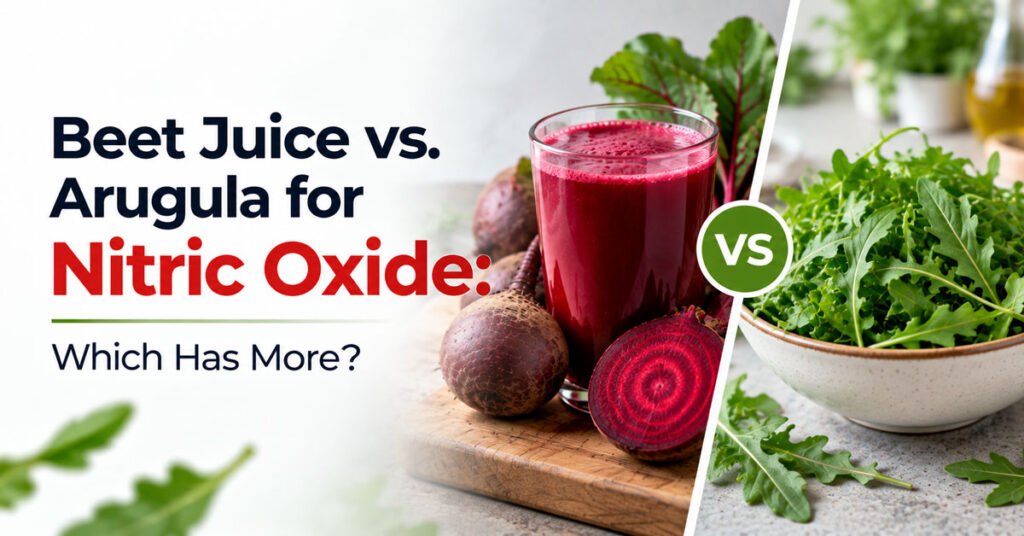
Beet Juice vs. Arugula: Which Has More Nitrate?
This is where the comparison becomes more complicated. Nitrate concentrations in vegetables are highly variable. They can change according to plant variety, soil conditions, fertilizer use, growing conditions, harvest time, storage, and preparation.
Studies and food-composition databases have generally identified arugula as one of the leafy vegetables that can have particularly high nitrate concentrations. Beetroot also provides meaningful amounts, and beetroot juice can provide a concentrated dose depending on the product.
| Factor | Beet Juice | Arugula |
|---|---|---|
| Nitrate source | Beetroot-derived nitrate | Naturally occurring nitrate |
| Concentration | Can be concentrated in a serving | Can be very high by weight |
| Convenience | Easy to measure and drink | Easy to add to meals |
| Fiber | Usually low, especially in filtered juice | Provides dietary fiber |
| Other nutrients | Provides compounds from beetroot | Provides vitamins, minerals, and plant compounds |
| Research interest | Extensively studied for nitrate and exercise | Leafy greens are well recognized as nitrate-rich foods |
So, asking which has “more” without specifying the serving size can be misleading. A food may have a high nitrate concentration by weight, while another may deliver more nitrate in the amount people typically consume.
Why Serving Size Changes the Answer
Imagine comparing two foods based only on nitrate per 100 grams. That can be useful for understanding concentration, but it does not necessarily represent what someone actually eats or drinks.
A person may consume a relatively small amount of arugula as part of a salad, while a measured serving of beet juice may contain a concentrated amount of beetroot-derived nitrate.
This is why researchers often pay attention to the actual nitrate dose rather than simply labeling a food “high nitrate.”
For a real-world comparison, the nitrate content of the serving you actually consume matters more than a simple ranking of foods.
Which One Is Better for Exercise?
Beetroot juice has received considerable attention in sports nutrition research. Dietary nitrate has been studied for potential effects on oxygen efficiency, endurance, muscular performance, and exercise tolerance.
Some studies have reported improvements in specific exercise outcomes after nitrate consumption, while others have found little or no meaningful benefit. Reviews suggest that the effects can depend on the type and duration of exercise, nitrate dose, timing, training status, and individual characteristics.
Arugula contains nitrate too, so it can contribute to the same general dietary pathway. However, research often uses standardized nitrate doses, making it difficult to assume that eating an ordinary serving of arugula will produce the same outcome as a standardized beetroot preparation.
Beet Juice vs. Arugula for Daily Nutrition
If you are thinking about your overall diet rather than a specific workout, arugula has some clear practical advantages. It is a whole vegetable that can contribute fiber and micronutrients while adding nitrate to your diet.
Beetroot itself can also be eaten whole, which provides more of the food matrix than filtered juice. Beet juice is simply more convenient for people who prefer a measured beverage.
There is no need to choose one exclusively. You can enjoy leafy greens regularly and include beetroot or beet juice when it fits your preferences.
A varied diet can give you several nitrate-rich foods instead of relying on one source.
Does Cooking Affect Nitrate?
Preparation can influence the nutrient composition of vegetables. Washing, cutting, boiling, steaming, and other cooking methods can change nitrate levels to different degrees.
There is no single rule saying that raw vegetables are always superior. The effect depends on the food and preparation method. For everyday eating, the more useful approach is to consume a variety of vegetables in forms that you enjoy and can maintain consistently.
Arugula is commonly eaten raw, while beetroot can be eaten raw or cooked. Beet juice is processed differently, and its nitrate concentration depends heavily on how the product is manufactured.
What About Oral Bacteria?
The mouth plays an important role in the dietary nitrate pathway. After nitrate is consumed, salivary glands concentrate nitrate in saliva, where certain oral bacteria can help convert it into nitrite.
This is one reason researchers have investigated whether disrupting oral bacteria can influence the response to dietary nitrate. Some studies suggest that strong antibacterial mouthwash can reduce nitrate-to-nitrite conversion and alter some effects of nitrate consumption.
This does not mean you should stop brushing your teeth or ignore dental care. Oral hygiene remains important. If you regularly use antiseptic mouthwash and are specifically interested in dietary nitrate, discussing your routine with a dental or healthcare professional may be worthwhile.
Can Beetroot and Arugula Increase Nitric Oxide?
It is more accurate to say that nitrate-rich foods can support the biochemical pathway that contributes to nitric oxide availability. The amount of nitric oxide ultimately produced depends on multiple factors, including nitrate intake, oral bacteria, oxygen availability, tissue conditions, and individual physiology.
Therefore, neither beet juice nor arugula should be described as a guaranteed nitric oxide booster. Their effects are better understood as part of normal dietary nitrate metabolism.
Eating a nitrate-rich food does not guarantee a specific change in blood flow, blood pressure, or athletic performance.
What If You Prefer a Nitric Oxide Supplement?
Some people prefer supplements because they provide a consistent combination of ingredients without requiring changes to their daily meals. Depending on the product, formulas may contain beetroot, L-citrulline, L-arginine, or other nutrients associated with nitric oxide pathways.
CircO2 Nitric Oxide Supplement is one option you may come across. Its formula includes beetroot powder and L-citrulline, along with vitamin C, vitamin B12, magnesium, and other ingredients. It is provided as a quick-dissolve tablet and should be used according to the manufacturer’s directions.
Want a convenient way to add nitric oxide-supporting ingredients to your routine? CircO2 combines beetroot and L-citrulline in a quick-dissolve supplement designed for convenient daily use.
Explore CircO2 & Check the Current Offer
We may earn a commission if you purchase through links on this site, at no additional cost to you.
Which Should You Choose?
If your priority is whole-food nutrition, arugula is an excellent choice. It can provide dietary nitrate while also contributing fiber and other nutrients. It is inexpensive, versatile, and easy to add to everyday meals.
If convenience and a concentrated nitrate source are more important, beet juice may be appealing. It has been extensively studied in exercise and cardiovascular research, although the results should not be interpreted as a guarantee of individual benefits.
| Your Priority | Practical Choice |
|---|---|
| Whole-food nutrition | Arugula |
| Easy meal addition | Arugula |
| Convenient concentrated drink | Beet juice |
| Dietary nitrate variety | Use both |
| Consistent supplement format | Consider a suitable nitric oxide supplement |
Beet Juice vs. Arugula: The Bottom Line
So, which has more nitrate: beet juice or arugula? There is no simple answer without specifying the nitrate concentration and serving size. Arugula can be exceptionally rich in nitrate by weight, while beet juice can provide a concentrated and convenient serving of beetroot-derived nitrate.
Both foods can fit into a diet designed to support the nitrate-nitrite-nitric oxide pathway. For everyday nutrition, arugula and other leafy greens offer the additional benefits of whole vegetables. Beet juice can be useful when convenience and a measured serving are priorities.
Rather than choosing a single “winner,” consider using both as part of a varied diet that includes plenty of vegetables, regular physical activity, and other habits that support cardiovascular health.
Important Disclaimer
This article is for educational purposes only and is not intended to provide medical advice, diagnosis, or treatment. Dietary supplements are not intended to diagnose, treat, cure, or prevent disease. If you have a medical condition, take prescription medications, are pregnant or breastfeeding, or are considering a nitric oxide supplement, speak with a qualified healthcare professional before making significant changes to your routine.